
Cardiac organoids show potential for myocardial repair after infarction
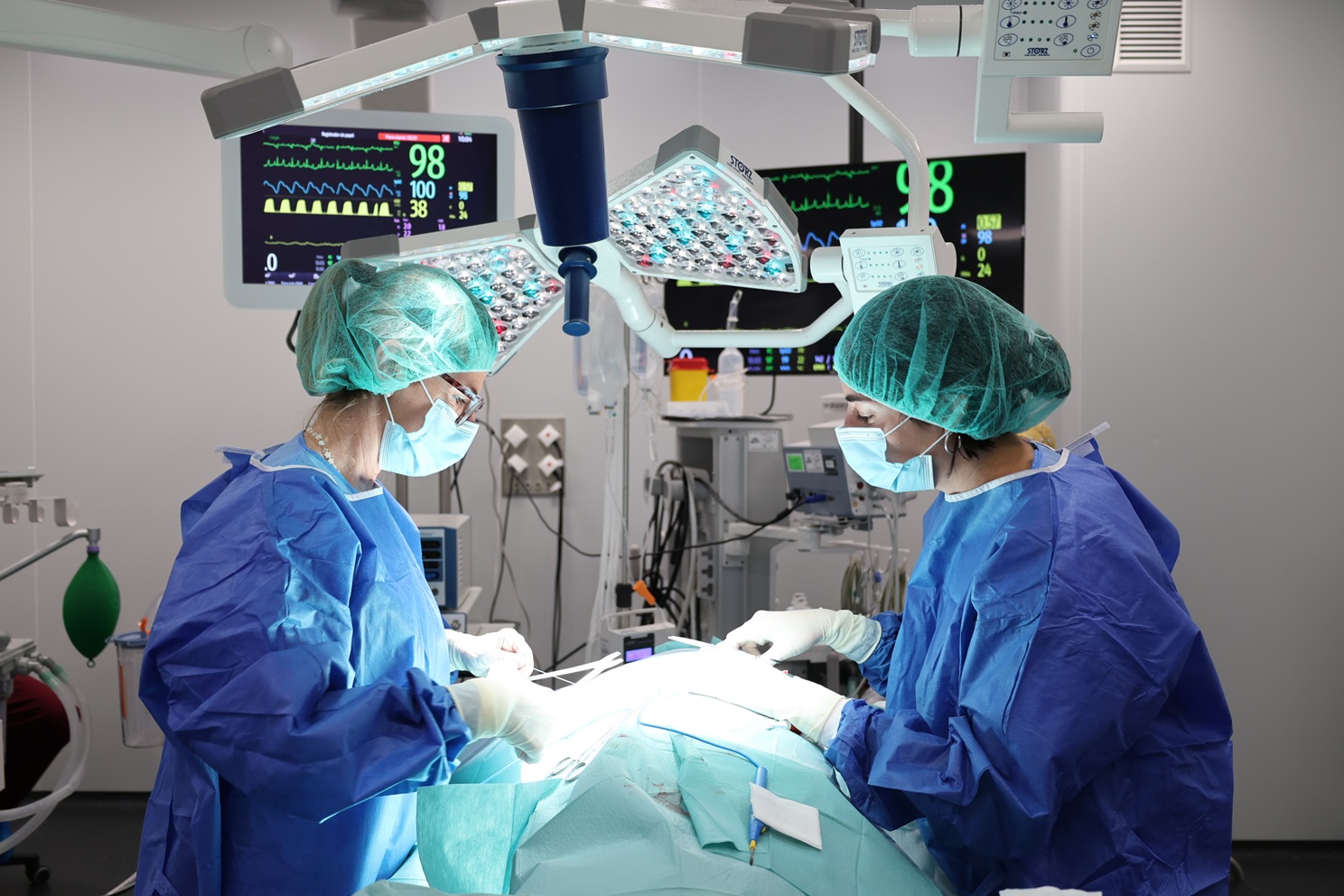
Researchers from the ICREC group during the preclinical phase in a porcine model
Myocardial infarction remains one of the leading causes of death worldwide. Following an infarction, part of the heart muscle is irreversibly damaged and replaced by scar tissue, which, while structurally necessary, compromises cardiac function and may lead to chronic heart failure.
Current treatments focus on restoring blood flow and managing symptoms but do not address the loss of functional heart tissue. Cell-based therapies have been explored as a potential regenerative approach; however, their clinical translation has been limited by challenges related to cell survival, scalability and safety, including the risk of arrhythmias.
In a study recently published in the journal Theranostics, a research team led by Dr Carolina Gálvez-Montón (Germans Trias i Pujol Research Institute -IGTP-, Heart Failure and Cardiac Regeneration -ICREC- group) and Dr Kurt Pfannkuche (University of Cologne) reports the development of a strategy based on cardiac organoids to address these limitations.
Cardiac organoids are three-dimensional tissue constructs that replicate key structural and functional features of the human heart. In this study, the researchers established a bioreactor-based production system enabling the generation of these organoids at a scale compatible with potential clinical applications.
The approach was evaluated in a preclinical model of myocardial infarction in pigs at the Comparative Medicine and Bioimage Centre of Catalonia (CMCiB). The results show that the organoids were able to integrate into the host tissue, were associated with improved cardiac function, and contributed to a reduction in scar size. No arrhythmogenic effects were observed under the conditions tested.
"This work provides a new approach to addressing the limitations of cell-based therapies in the context of myocardial infarction, particularly in terms of scalability and safety," says Dr Carolina Gálvez-Montón. "Although these are preclinical results, they open the door to further advances in the development of regenerative strategies based on organoids."
These findings support the potential of cardiac organoids as a platform for regenerative therapies and provide a basis for further studies aimed at assessing their safety and efficacy in clinical settings.
Reference
Hamad, S.; Aksoy, E.; Kalil, M.; Martínez-Falguera, D.; Jüngst, C.; Zahn, K.; Gaedke, F.; Peinkofer, G.; Boukens, B.J.; Firuzi, R.; Prause, R.; Aranyo, J.; Bisbal, F.; Iborra-Egea, O.; Jorge, E.; Iraola-Picornell, G.; Teis, A.; de Raffele, M.; Delgado, V.; Nitsche, F.; Sachinidis, A.; Khalil, M.; Alhashimi, F.; Schauss, A.; Bayes-Genis, A.; Gálvez-Montón, C.; Pfannkuche, K.P. Scalable differentiation of human cardiac organoids from iPSCs generates cardiac tissues for cardiac cell therapy. Theranostics 2026, 16 (12), 6437-6462. DOI: 10.7150/thno.127654.
Funding
The European Fund for Regional Development and the State North Rhine-Westphalia supported this project in frame of Leitmarkt-NRW project no. EFRE-0801775. The state of North Rhine-Westphalia provided further support in frame of the project PERIDIAN. Further support was provided by the Marga and Walter Boll Foundation, Kerpen, Germany. The A.M. Wilsing Foundation, Cologne, Germany supported the work of Katharina Zahn and provided funds for a microscope. The Elisabeth and Rudolf Hirsch-Foundation for Medical Research, Cologne, Germany supported pilot transplantation experiments. Sarkawt Hamad received funding from the Köln Fortune program. Funding for instrumentation: JEOL JEM2100 Plus: DFG-INST 216/793-1 FUGG.
This work was also supported in part by grants from the Spanish Ministry of Economy and Competitiveness-MICINN (PID2022-142219OB-I00, PID2021-124703OB-I00), and the Instituto de Salud Carlos III under Grants CIBERCV (CB16/11/00403) as a part of the Plan Nacional de I+D+I, and was co-funded by ISCIII-Subdirección General de Evaluación y el Fondo Europeo de Desarrollo Regional (FEDER), and AGAUR Generalitat de Catalunya (2021-SGR-01437).